Extract parameter simulations from the joint precision matrix
Source:R/gather-spread.R
gather_sims.Rdspread_sims() returns a wide-format data frame. gather_sims() returns a
long-format data frame. The format matches the format in the tidybayes
spread_draws() and gather_draws() functions.
Arguments
- object
Output from
sdmTMB().- nsim
The number of simulation draws.
Value
A data frame. gather_sims() returns a long-format data frame:
.iteration: the sample ID.variable: the parameter name.value: the parameter sample value
spread_sims() returns a wide-format data frame:
.iteration: the sample IDcolumns for each parameter with a sample per row
Examples
m <- sdmTMB(density ~ depth_scaled,
  data = pcod_2011, mesh = pcod_mesh_2011, family = tweedie())
head(spread_sims(m, nsim = 10))
#>   .iteration X.Intercept. depth_scaled    range      phi tweedie_p  sigma_O
#> 1          1     2.903231   -0.5205483 28.06440 16.02173  1.569018 2.095025
#> 2          2     2.594193   -0.5693215 40.17931 16.17853  1.556120 1.826335
#> 3          3     3.197205   -0.8617446 47.15718 14.71530  1.597992 1.925214
#> 4          4     3.510531   -0.6283991 17.08680 15.70606  1.583781 2.350573
#> 5          5     2.713482   -0.7645729 24.53404 14.34188  1.572464 2.425859
#> 6          6     2.789035   -0.6301272 33.83201 14.27102  1.602406 1.769855
head(gather_sims(m, nsim = 10))
#>   .iteration    .variable   .value
#> 1          1 X.Intercept. 3.423201
#> 2          2 X.Intercept. 3.167973
#> 3          3 X.Intercept. 2.762833
#> 4          4 X.Intercept. 3.459236
#> 5          5 X.Intercept. 2.705132
#> 6          6 X.Intercept. 2.739150
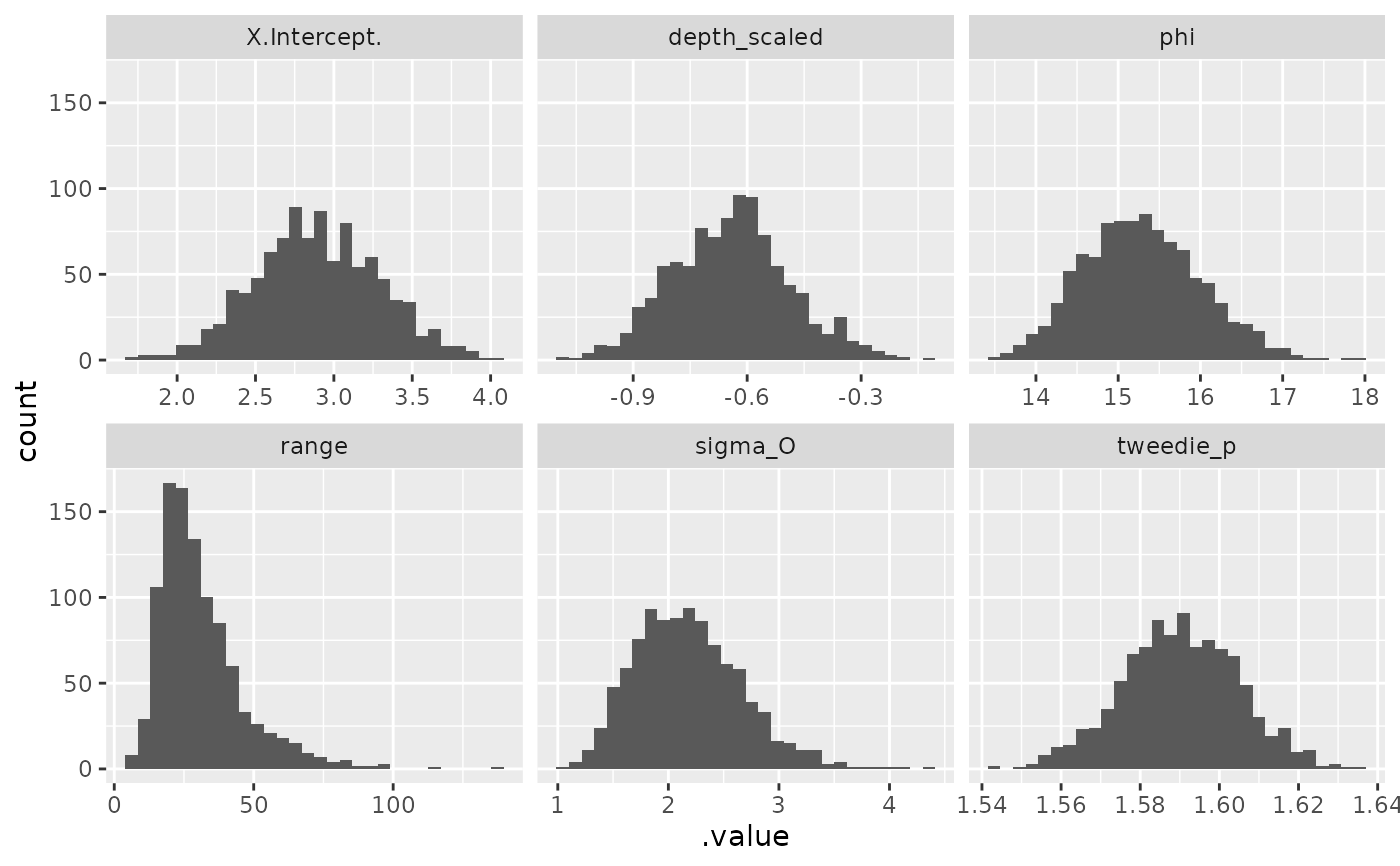
samps <- gather_sims(m, nsim = 1000)

if (require("ggplot2", quietly = TRUE)) {
  ggplot(samps, aes(.value)) + geom_histogram() +
    facet_wrap(~.variable, scales = "free_x")
}
#> `stat_bin()` using `bins = 30`. Pick better value `binwidth`.