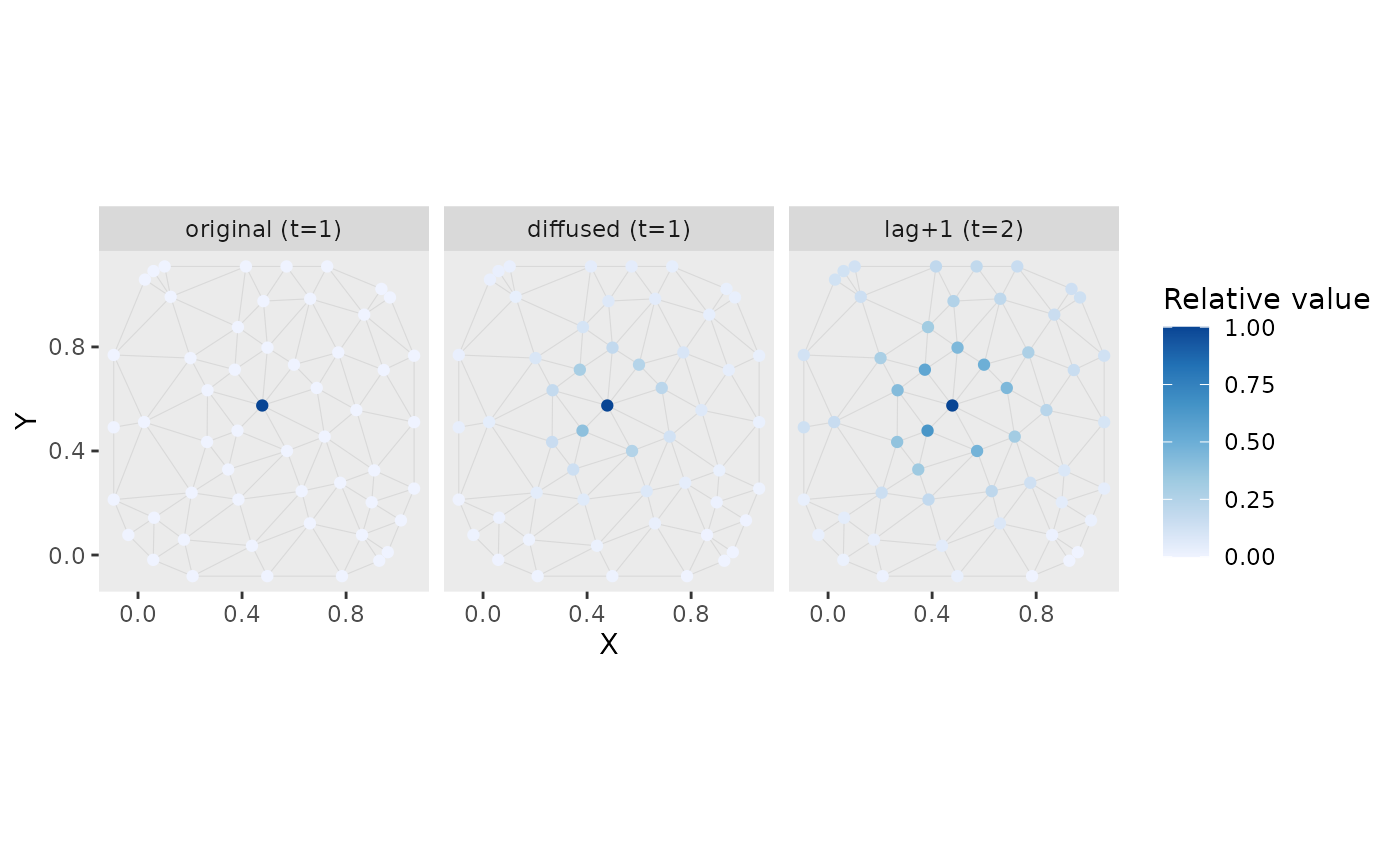
Visualize fitted covariate-diffusion transforms or impulse-response kernels
for one selected covariate-diffusion term.
By default, values are plotted at mesh vertices with the mesh edges shown in
light grey. Values can also be evaluated at supplied newdata coordinates
and plotted as points or a raster.
Usage
plot_nonlocal_covariate(
  object,
  component,
  newdata = NULL,
  type = c("point", "raster"),
  covariate = NULL,
  time_value = 1,
  n_steps = 1L,
  common_scale = TRUE
)

plot_nonlocal_kernel(
  object,
  component,
  newdata = NULL,
  type = c("point", "raster"),
  covariate = NULL,
  time_value = 1,
  n_steps = 3L,
  common_scale = FALSE
)
Arguments
- object
A fitted
sdmTMB()model withnonlocal_formula.- component
Covariate-diffusion component name. Must be one of
"diffusion","time_lag", or"combined"."combined"plots the fitted joint operator and requires both wrappers forcovariate.- newdata
Optional data frame with x/y coordinate columns matching the fitted mesh. If supplied, values are evaluated at the unique
newdatacoordinates. IfNULL, values are evaluated at mesh vertices.- type
Plot type:
"point"or"raster"."raster"requiresnewdata.- covariate
Optional covariate name from
nonlocal_formula. Required when multiple lag covariates were fitted.- time_value
Optional time slice to plot or use for the impulse. Supply either a modeled time value or a 1-based time index. Defaults to 1.
- n_steps
Number of transformed slices to plot starting at
time_value.- common_scale
Should the plotted panels share a common color scale? Defaults to
TRUEforplot_nonlocal_covariate()andFALSEforplot_nonlocal_kernel().component = "time_lag"alone likely needscommon_scale = TRUEto make sense.
Details
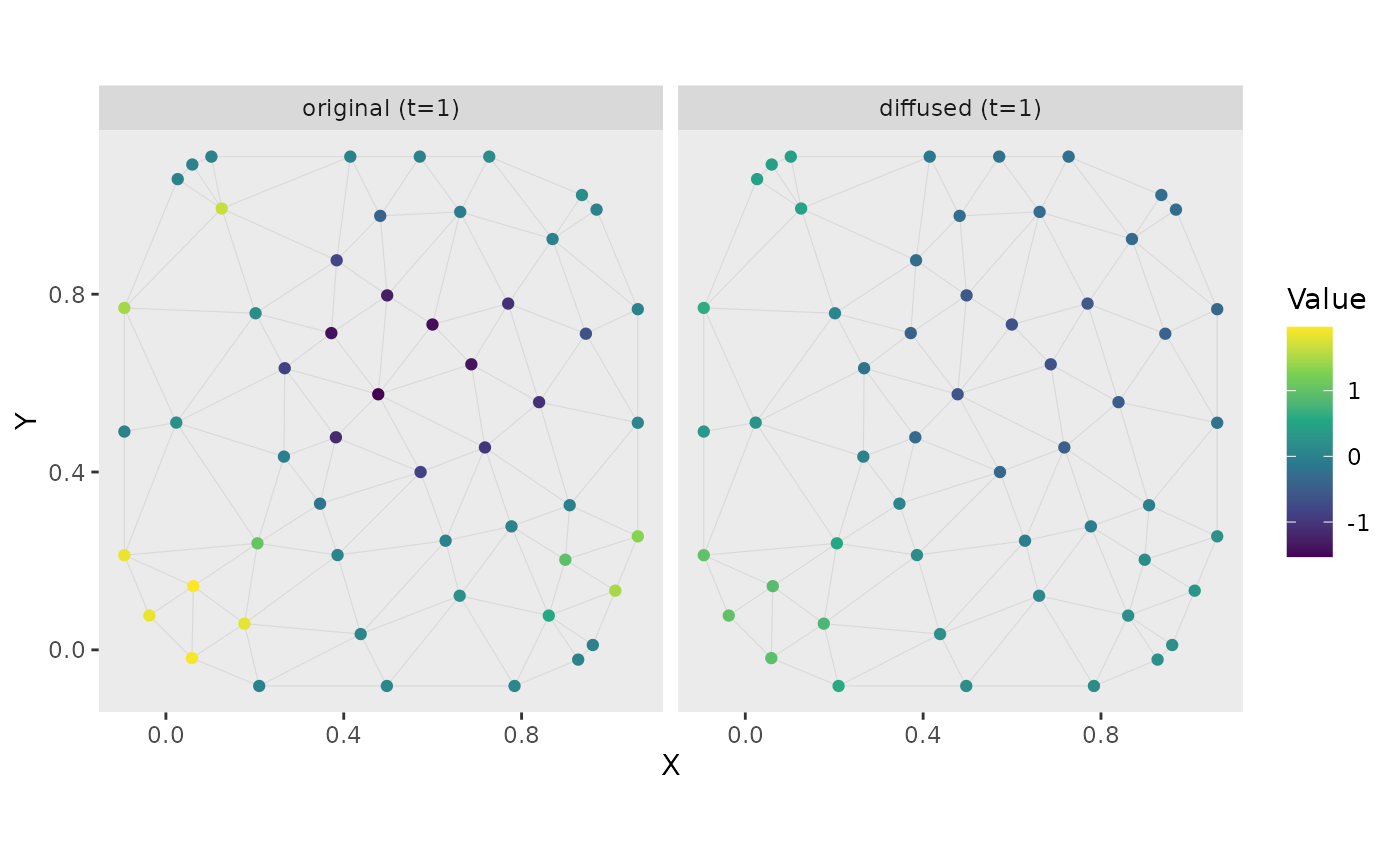
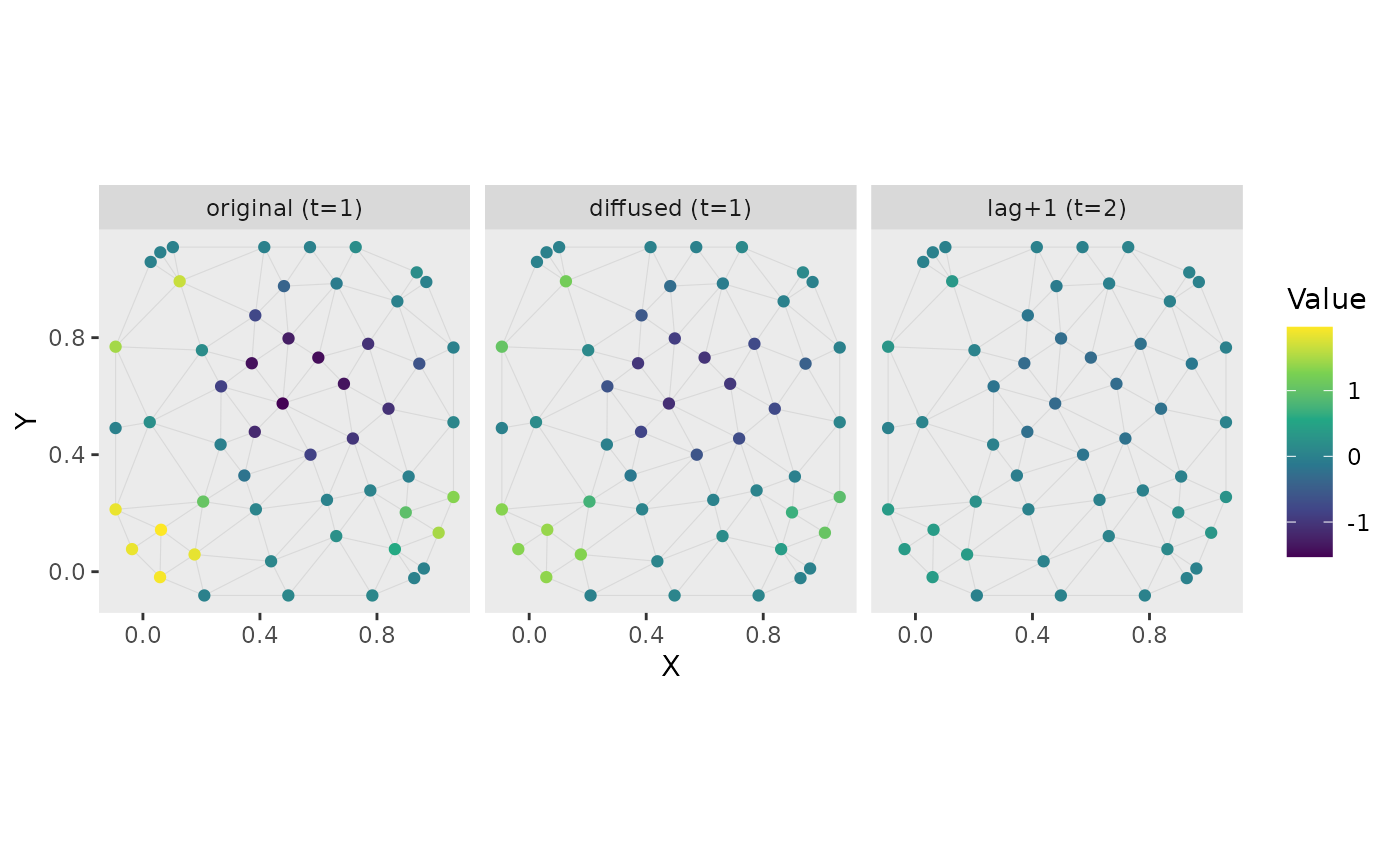
plot_nonlocal_covariate() visualizes the original mesh-vertex covariate
field and its fitted covariate-diffusion transform for one selected
covariate time slice across one or more lagged output time slices.
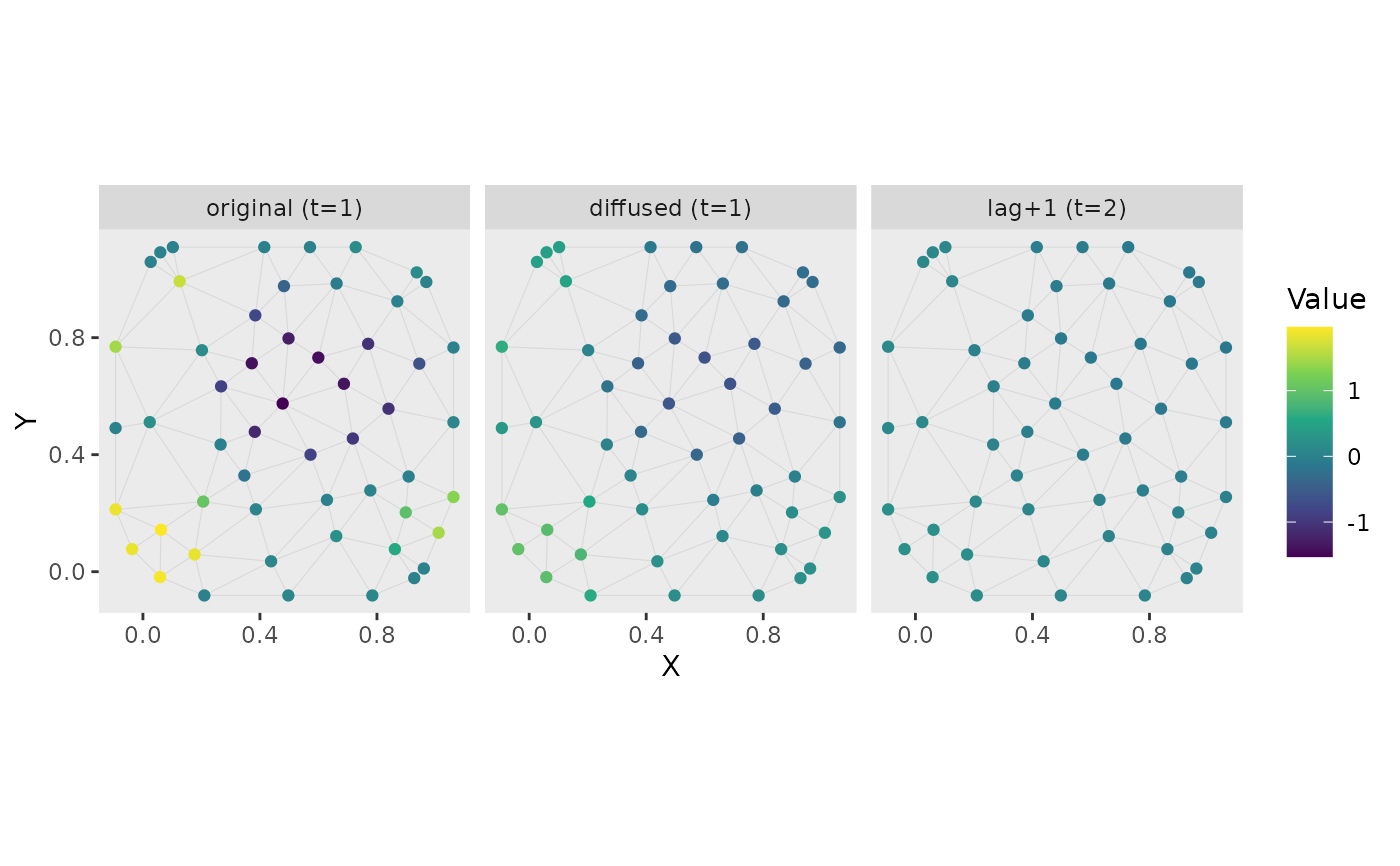
When both diffusion() and time_lag() were fitted for the same covariate,
component = "combined" visualizes the single stationary joint operator
represented by that covariate's transformed prediction column.
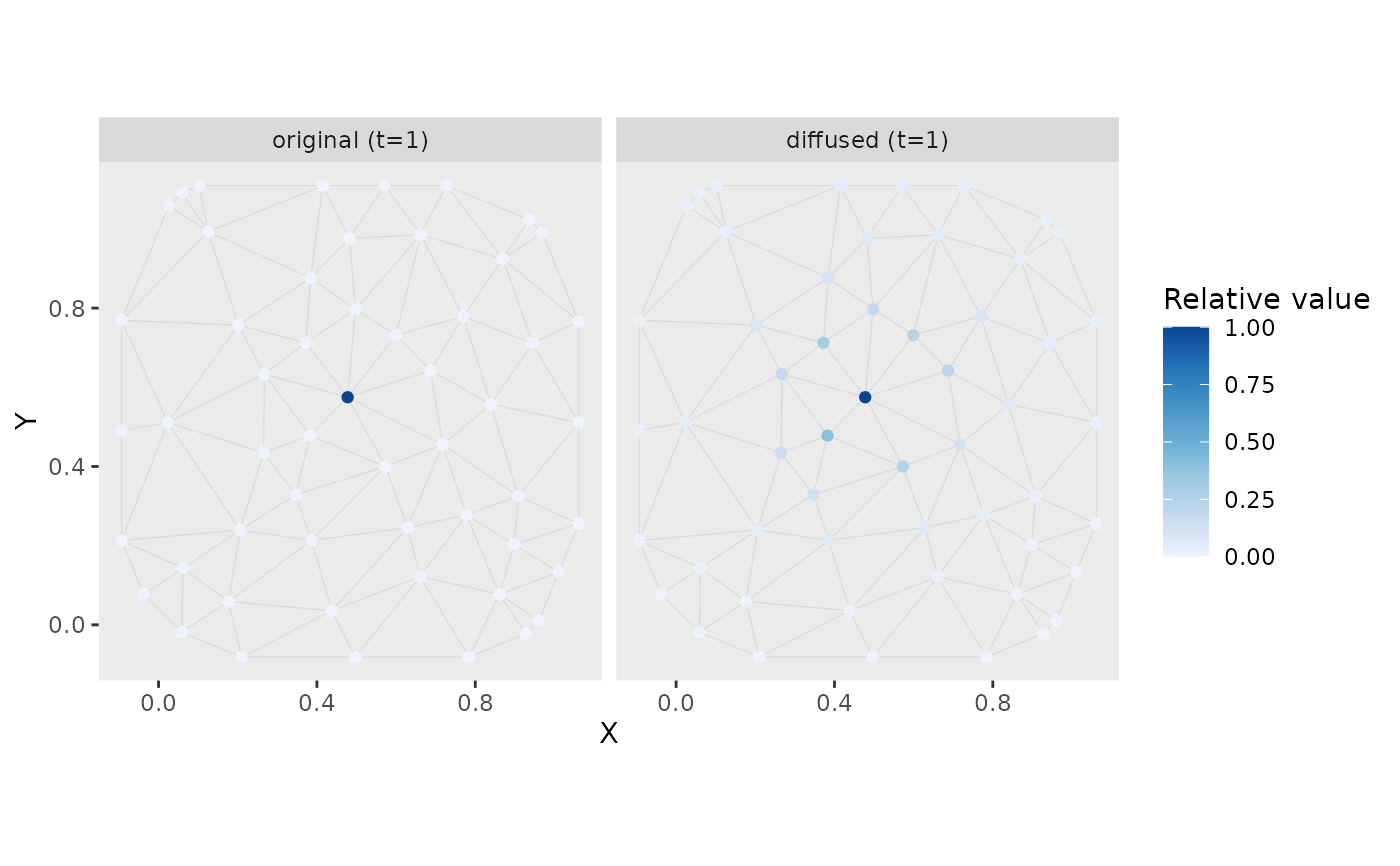
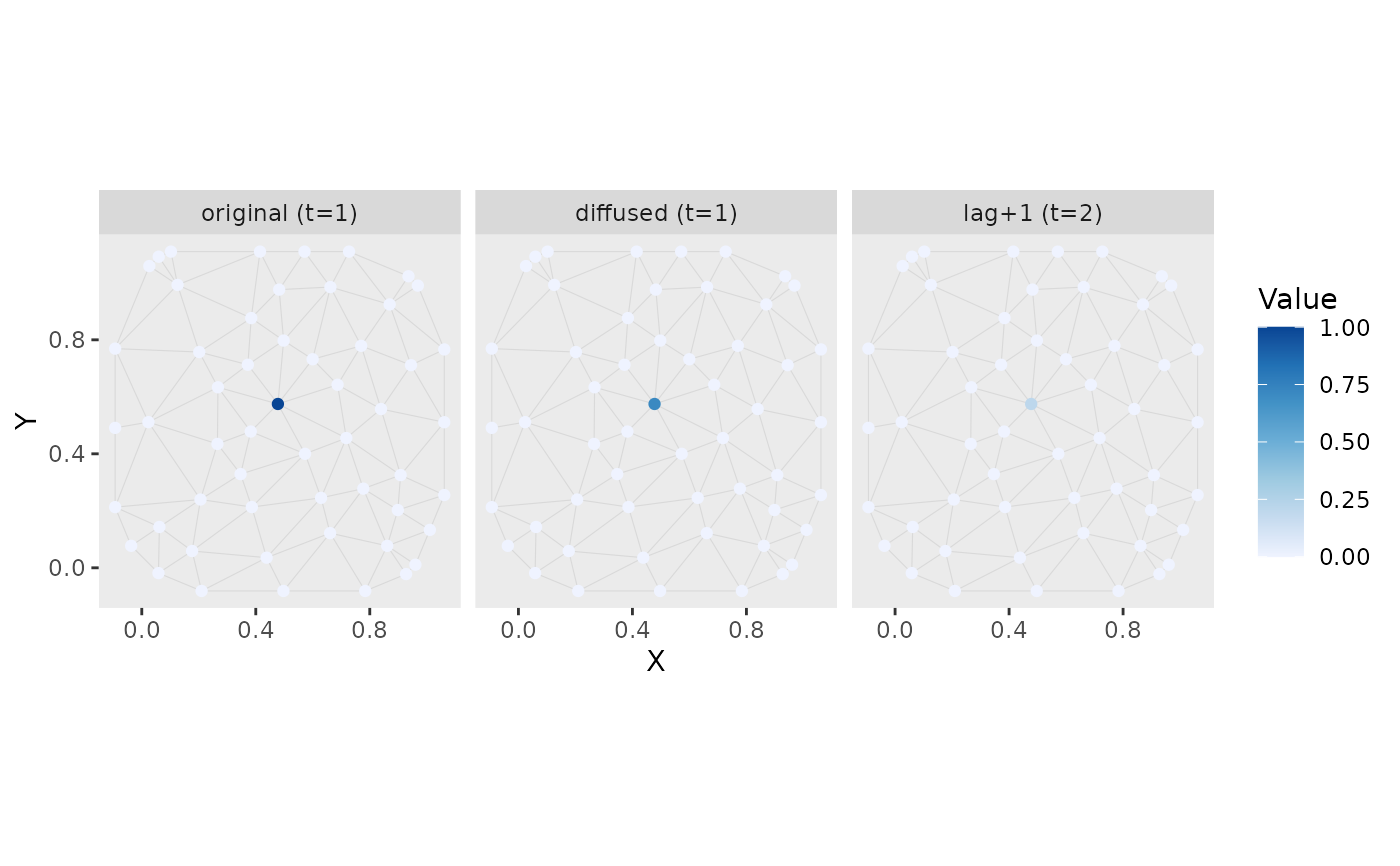
plot_nonlocal_kernel() visualizes an impulse entering and diffusing through
one covariate-diffusion component.
Examples
# Simulate some data for fitting:
set.seed(1)
n_t <- 6
n_sites <- 80
sites <- data.frame(X = runif(n_sites), Y = runif(n_sites))
dat <- data.frame(
X = rep(sites$X, times = n_t),
Y = rep(sites$Y, times = n_t),
year = rep(seq_len(n_t), each = n_sites)
)
dat$x1 <- as.numeric(scale(
sin(2 * pi * (dat$X + dat$year / 6)) +
cos(2 * pi * (dat$Y - dat$year / 8)) +
0.4 * sin(4 * pi * dat$X) * cos(dat$year / 2) +
rnorm(nrow(dat), sd = 0.15)
))
mesh <- make_mesh(dat, xy_cols = c("X", "Y"), cutoff = 0.12)
nonlocal_data <- merge(
data.frame(year = seq_len(n_t)),
setNames(as.data.frame(mesh$mesh$loc[, 1:2]), c("X", "Y"))
)
nonlocal_data$x1 <- as.numeric(scale(
sin(2 * pi * (nonlocal_data$X + nonlocal_data$year / 6)) +
cos(2 * pi * (nonlocal_data$Y - nonlocal_data$year / 8)) +
0.4 * sin(4 * pi * nonlocal_data$X) * cos(nonlocal_data$year / 2)
))
sim <- simulate_new(
formula = ~ 1,
data = dat,
mesh = mesh,
time = "year",
family = gaussian(),
spatial = "off",
spatiotemporal = "off",
range = 0.3,
sigma_O = 0,
sigma_E = 0,
phi = 0.1,
B = c(0, 0.7),
nonlocal_formula = ~ diffusion(x1) + time_lag(x1),
nonlocal_data = nonlocal_data,
lags_kappaS = 4.4,
lags_rhoT = 0.3,
seed = 123
)
dat$observed <- sim$observed
# Fit the model:
fit <- sdmTMB(
observed ~ 1,
data = dat,
mesh = mesh,
time = "year",
spatial = "off", # keeping example simple
spatiotemporal = "off", # keeping example simple
family = gaussian(),
nonlocal_formula = ~ diffusion(x1) + time_lag(x1), #<
nonlocal_data = nonlocal_data
)
plot_nonlocal_covariate(
fit,
covariate = "x1",
component = "diffusion"
)
 plot_nonlocal_covariate(
fit,
covariate = "x1",
component = "time_lag",
time_value = 1,
n_steps = 2
)
plot_nonlocal_covariate(
fit,
covariate = "x1",
component = "time_lag",
time_value = 1,
n_steps = 2
)
 plot_nonlocal_covariate(
fit,
covariate = "x1",
component = "combined",
time_value = 1,
n_steps = 2
)
plot_nonlocal_covariate(
fit,
covariate = "x1",
component = "combined",
time_value = 1,
n_steps = 2
)
 plot_nonlocal_kernel(
fit,
covariate = "x1",
component = "diffusion"
)
plot_nonlocal_kernel(
fit,
covariate = "x1",
component = "diffusion"
)
 plot_nonlocal_kernel(
fit,
covariate = "x1",
component = "time_lag",
time_value = 1,
n_steps = 2,
common_scale = TRUE #<
)
plot_nonlocal_kernel(
fit,
covariate = "x1",
component = "time_lag",
time_value = 1,
n_steps = 2,
common_scale = TRUE #<
)
 plot_nonlocal_kernel(
fit,
covariate = "x1",
component = "combined",
time_value = 1,
n_steps = 2
)
plot_nonlocal_kernel(
fit,
covariate = "x1",
component = "combined",
time_value = 1,
n_steps = 2
)