
Estimating non-local covariate effects with sdmTMB: spatial diffusion and time lags
2026-10-03
Source:vignettes/articles/nonlocal-covariates.Rmd
nonlocal-covariates.RmdIf the code in this vignette has not been evaluated, a rendered version is available on the documentation site under ‘Articles’.
This vignette demonstrates non-local-covariate models using simulated data. These models could alternatively be described as “distributed lag” models or, in the case of spatial diffusion, “covariate diffusion” models.
When might you want to fit these models? Sometimes, the spatial or temporal scale at which covariates influence the response is unclear.
For example, fish move. Therefore, if we measure temperature at the location where a fish was sampled, it may be unclear whether the model should use the temperature at the sampling site or a smoothed version of the temperature surface that accounts for fish movement and integration over a broader spatial range.
One option is to fit models using covariates with different levels of smoothing and compare them. Alternatively, we can estimate the appropriate degree of smoothing simultaneously while we fit the model. This is what the covariate-diffusion functionality does.
Users are encouraged to read and cite Lindmark et al. (2025) for spatial models and Thorson et al. (2026) for extensions to temporal and spatiotemporal settings, including the introduction of the MSDK and RMSDK terms.
We begin with a simple spatial-diffusion example and then fit an
example that combines diffusion() and
time_lag() terms.
Simple spatial diffusion example
We will start by simulating data with a fine-scale predictor
(x1) and a spatially diffused effect:
set.seed(1)
n_sites <- 220
site <- data.frame(X = runif(n_sites), Y = runif(n_sites))
dat <- site
mesh <- make_mesh(dat, c("X", "Y"), cutoff = 0.05)
nonlocal_space <- data.frame(
  X = mesh$mesh$loc[, 1],
  Y = mesh$mesh$loc[, 2]
)
nonlocal_space$x1 <- as.numeric(scale(
  sin(6 * pi * nonlocal_space$X) +
    cos(6 * pi * nonlocal_space$Y) +
    rnorm(nrow(nonlocal_space), sd = 1)
))
dat$x1 <- as.numeric(mesh$A_st %*% nonlocal_space$x1)

sim_space <- simulate_new(
  formula = ~ 1,
  data = dat,
  mesh = mesh,
  family = gaussian(),
  spatial = "off",
  spatiotemporal = "off",
  range = 0.2,
  sigma_O = 0,
  phi = 0.1,
  B = c(0, 0.8),
  nonlocal_formula = ~ diffusion(x1),
  nonlocal_data = nonlocal_space,
  lags_kappaS = 1.5,
  seed = 1
)

dat$observed <- sim_space$observed
dat$x1_truth <- sim_space$nl_truth_diffusion_x1
head(dat)
#>           X         Y         x1     observed    x1_truth
#> 1 0.2655087 0.2624741 -1.7055029 -0.073116797 -0.01308927
#> 2 0.3721239 0.1654539 -0.2216659  0.007108232 -0.01407013
#> 3 0.5728534 0.3221681 -0.4329922 -0.109571512 -0.03251081
#> 4 0.9082078 0.5101252 -1.6025141  0.119772355 -0.04969466
#> 5 0.2016819 0.9239685 -1.1300073  0.005831051 -0.03389966
#> 6 0.8983897 0.5109597 -1.4796643 -0.120935190 -0.04861044
Fit the matching covariate-diffusion model:
fit <- sdmTMB(
  observed ~ 1,
  mesh = mesh,
  nonlocal_formula = ~ diffusion(x1), #<
  nonlocal_data = nonlocal_space,
  spatial = "off",
  data = dat
)

fit
#> Model fit by ML ['sdmTMB']
#> Formula: observed ~ 1
#> Mesh: mesh (isotropic covariance)
#> Data: dat
#> Nonlocal formula: diffusion(x1)
#> Family: gaussian(link = 'identity')
#>
#> Conditional model:
#>                 coef.est coef.se
#> (Intercept)        -0.01    0.01
#> nl_diffusion_x1     0.22    0.27
#>
#> Dispersion parameter: 0.09
#> Nonlocal RMSDK: RMSDK[x1]=0.53
#> ML criterion at convergence: -206.752
#>
#> See ?tidy.sdmTMB to extract these values as a data frame.
tidy(fit)
#> # A tibble: 2 × 5
#>   term            estimate std.error conf.low conf.high
#>   <chr>              <dbl>     <dbl>    <dbl>     <dbl>
#> 1 (Intercept)     -0.00792   0.00913  -0.0258   0.00997
#> 2 nl_diffusion_x1  0.221     0.275    -0.317    0.760
tidy(fit, effects = "ran_pars")
#> # A tibble: 4 × 5
#>   term          estimate std.error conf.low conf.high
#>   <chr>            <dbl>     <dbl>    <dbl>     <dbl>
#> 1 phi             0.0945   0.00451  0.0861      0.104
#> 2 kappaS_nl[x1]   3.77     3.31    -2.71       10.3
#> 3 MSDK[x1]        0.281    0.493    0.00903     8.73
#> 4 RMSDK[x1]       0.530    0.465    0.0951      2.96
Here kappaS_nl[x1] is the estimated spatial diffusion
scale parameter for x1 (larger values imply less
smoothing).
The output also reports MSDK[x1] and
RMSDK[x1], the implied mean-squared diffusion-kernel scale
(4 / kappaS_nl[x1]^2) and its square root
(2 / kappaS_nl[x1]). We describe these in the next section.
By default, log_kappaS_nl is bounded so that RMSDK stays
between half the shortest mesh edge and 10 times the mesh bounding-box
diagonal, where the likelihood is otherwise flat; a fit at a bound
triggers a warning. Supply lower or upper for
log_kappaS_nl in sdmTMBcontrol() to change
these.
SR, MSDK, RMSDK, MSD
Thorson et al. (2026) defines 3 quantities: SR, MSD, and MSDK (and MSDK’s square root: RMSDK).
SR is the “squared resolution”. When the covariate gets projected to the mesh vertices there’s a degree of smoothing. That’s what SR is.
MSDK is the “mean squared diffusion kernel”. It describes the amount of diffusion incorporating both the spatial and any estimate temporal diffusion.
MSD is the “mean squared diplacement”: It is the realized diffusion at a given time step. Effectively that means it’s SR + one MSDK per time step.
RMSDK is the square root of MSDK. This puts it back in distance units.
Currently, sdmTMB reports MSDK and RMSDK. SR and MSD require defining a fine-resolution grid. We may add these quantities in the future if there is interest.
Users using these MSDK and RMSDK metrics should consult and cite Thorson et al. (2026).
Compare true and estimated diffused covariates:
pred <- predict(fit)
pred$X <- dat$X
pred$Y <- dat$Y

cor(pred$nl_diffusion_x1, pred$x1_truth)
#> [1] 0.9599908

g1 <- ggplot(pred, aes(X, Y, colour = x1)) +
  geom_point(size = 0.7) +
  scale_colour_gradient2() +
  coord_equal() +
  ggtitle("Fine-scale observed predictor (x1)")

g2 <- ggplot(pred, aes(X, Y, colour = x1_truth)) +
  geom_point(size = 0.7) +
  scale_colour_gradient2() +
  coord_equal() +
  ggtitle("True diffused covariate (from simulation)")

g3 <- ggplot(pred, aes(X, Y, colour = nl_diffusion_x1)) +
  geom_point(size = 0.7) +
  scale_colour_gradient2() +
  coord_equal() +
  ggtitle("Estimated diffused covariate")

print(g1)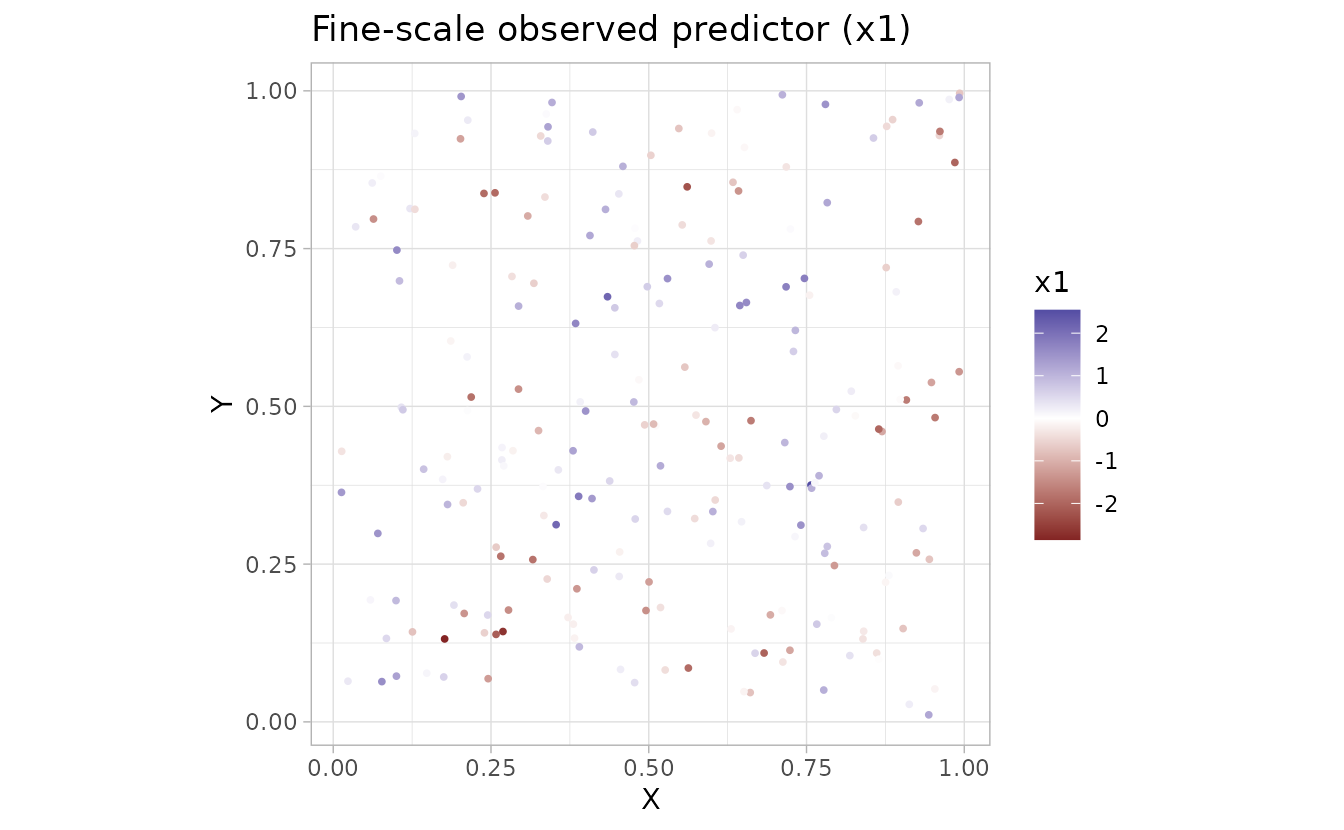
print(g2)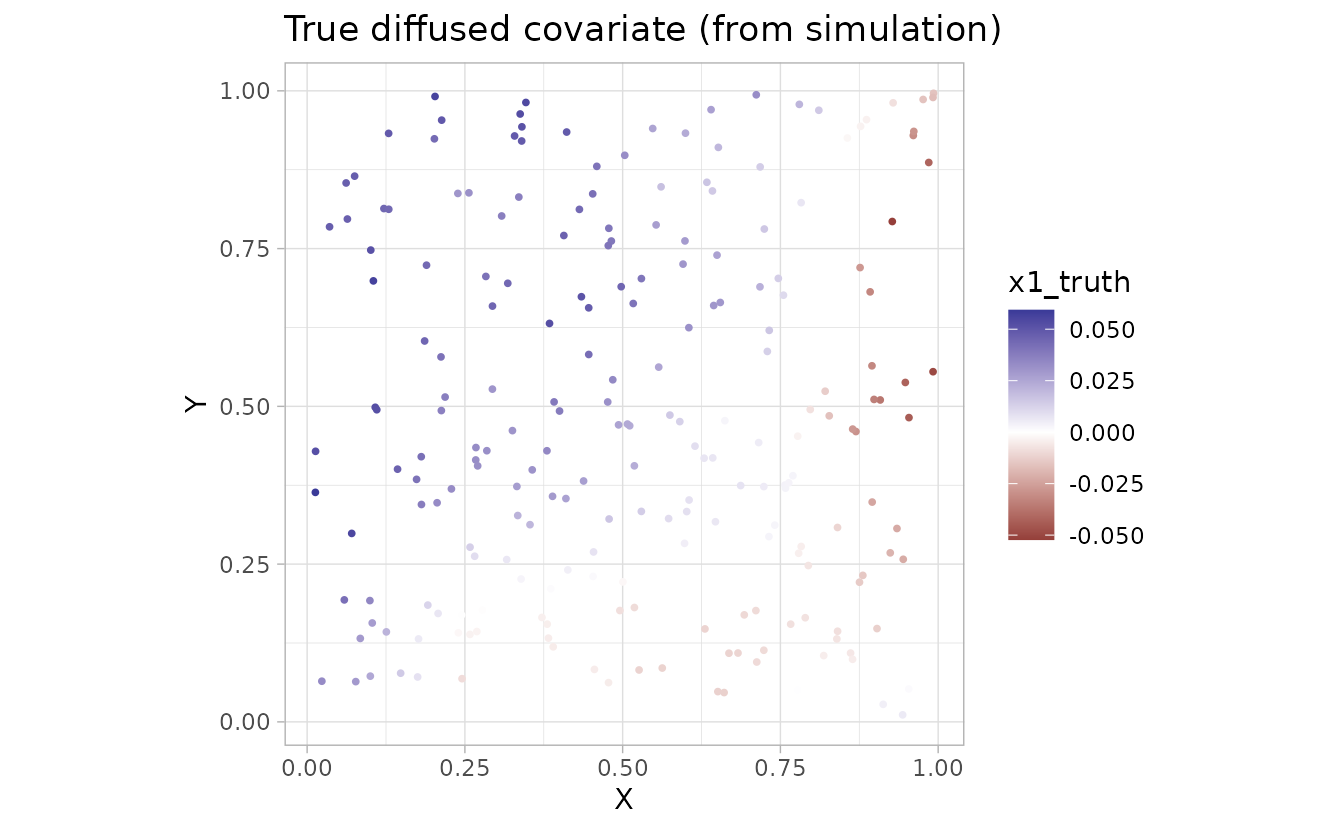
print(g3)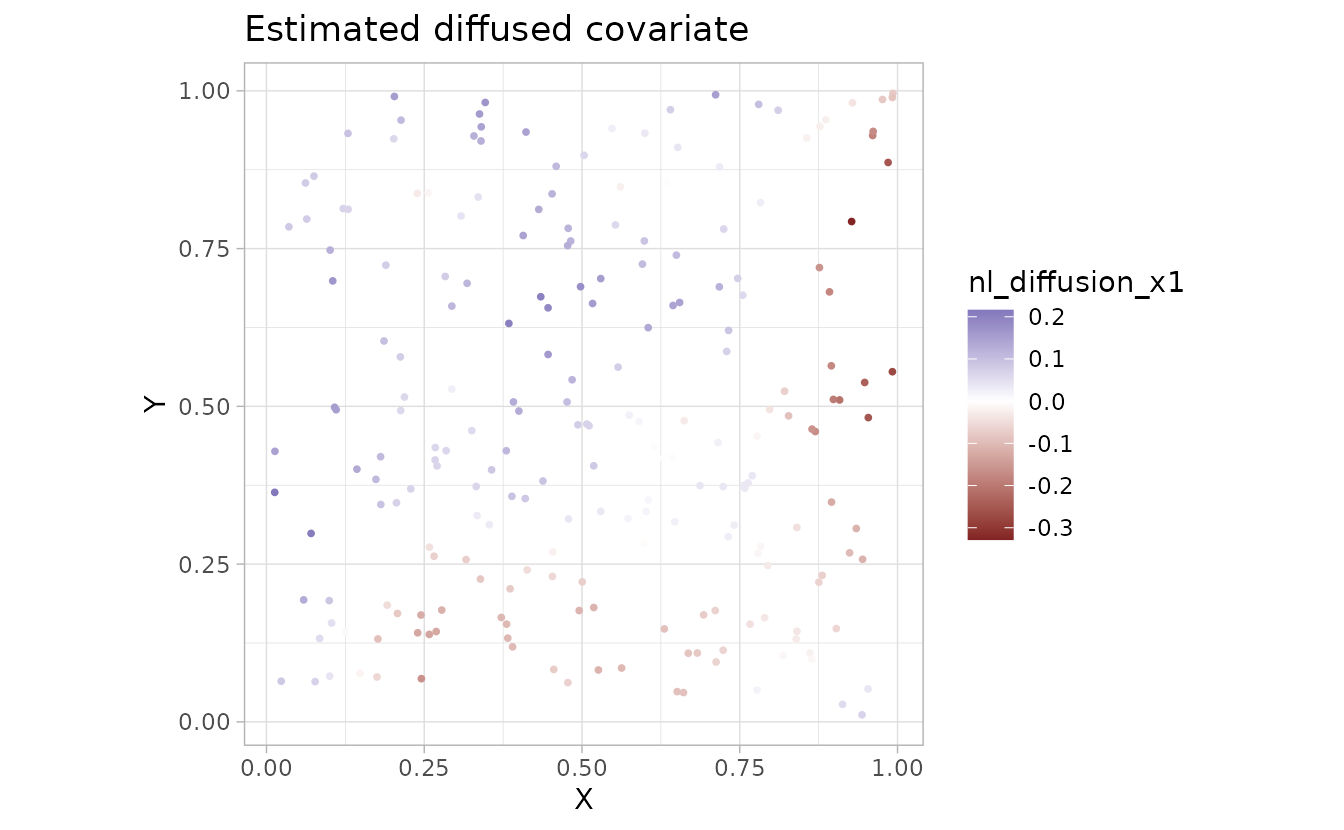
We can visualize the diffusion operator and the original and smoothed covariate on the mesh:
plot_nonlocal_kernel(fit, component = "diffusion")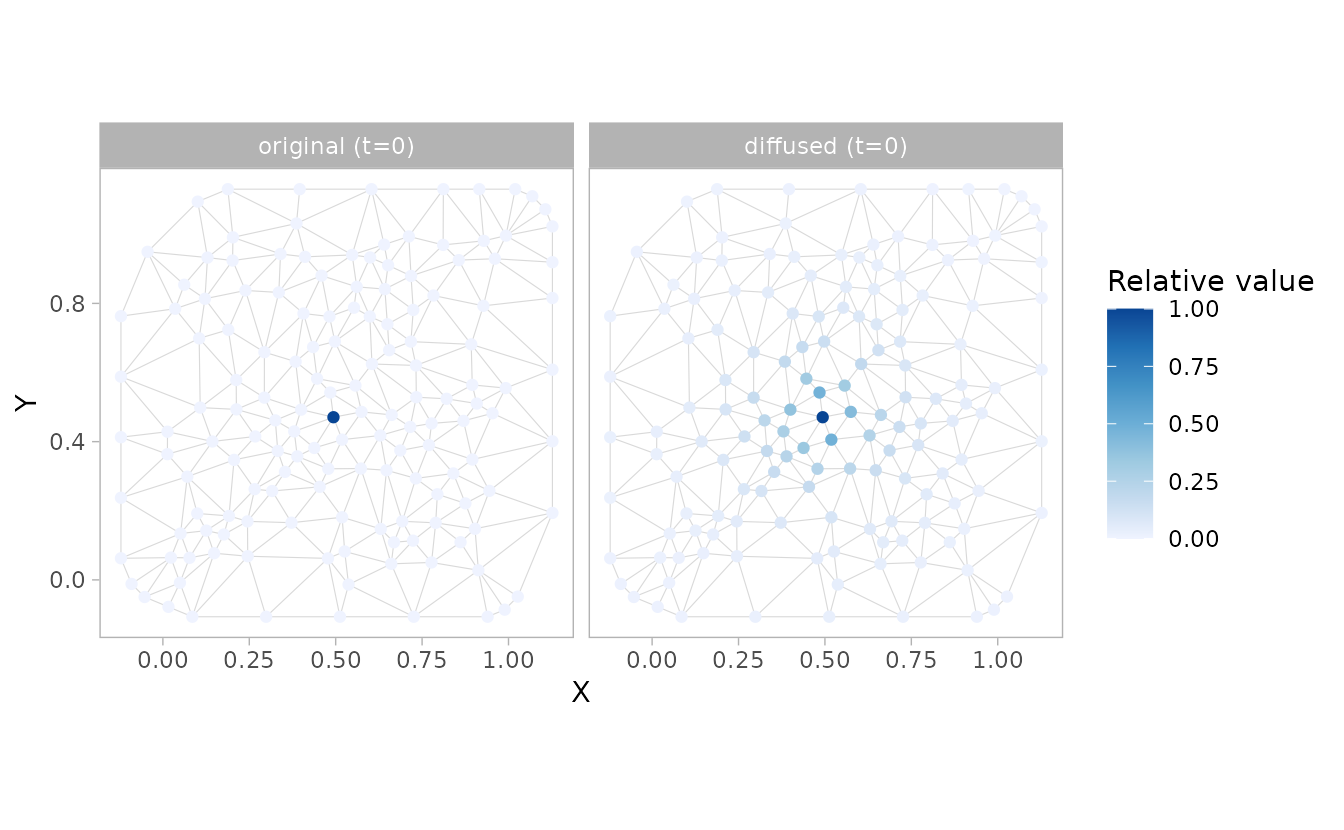
plot_nonlocal_covariate(fit, component = "diffusion")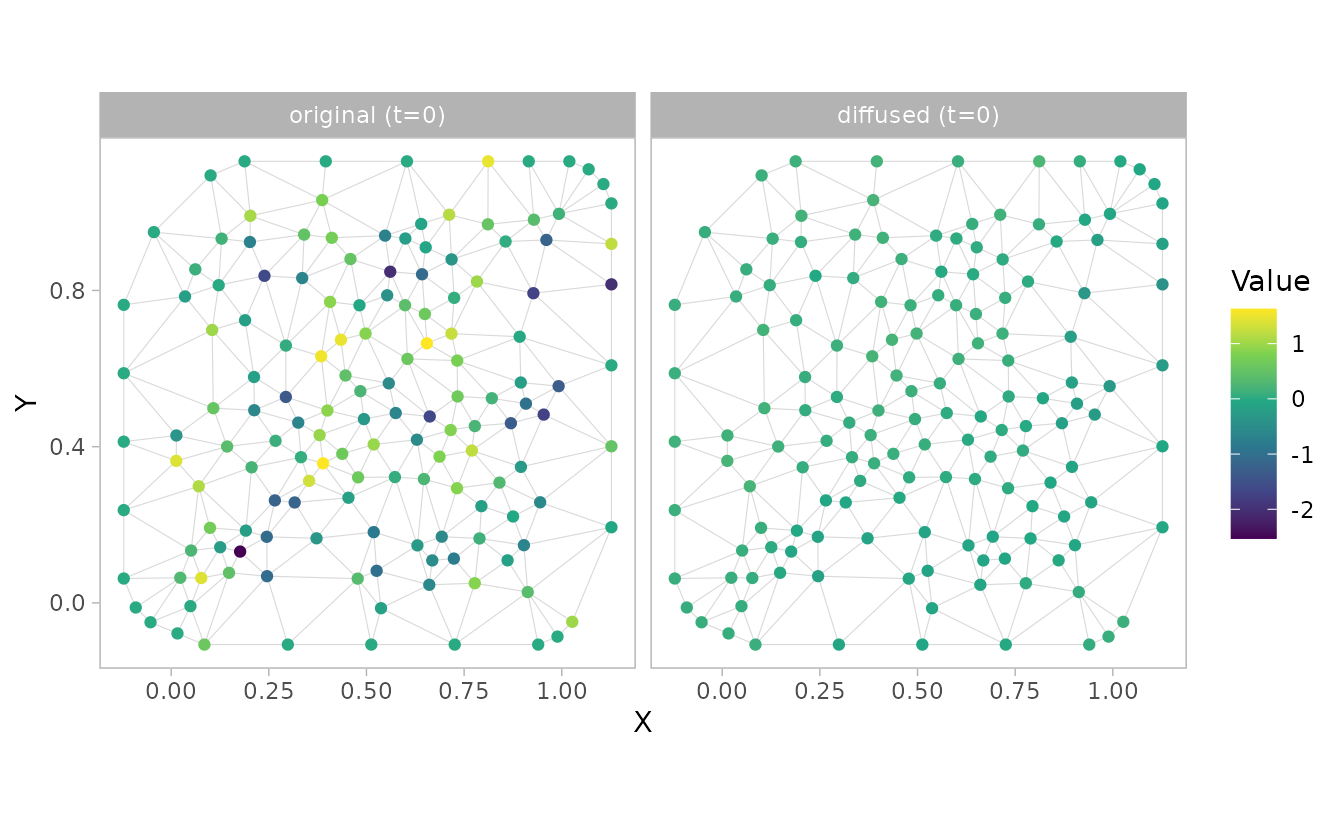
Space-time example with a joint operator
Next we will simulate and fit a model containing spatial and temporal
components: ~ diffusion(x1) + time_lag(x1). Because both
wrappers refer to x1, they select parts of one stationary
joint operator and produce one transformed predictor and one
coefficient. Wrappers applied to different covariates, such as
~ diffusion(x1) + time_lag(x2), produce separate predictors
and coefficients.
set.seed(1)
n_t <- 16
n_sites <- 300
site_st <- data.frame(X = runif(n_sites), Y = runif(n_sites))
dat_st <- data.frame(
  X = rep(site_st$X, times = n_t),
  Y = rep(site_st$Y, times = n_t),
  year = rep(seq_len(n_t), each = n_sites)
)
mesh_st <- make_mesh(dat_st, c("X", "Y"), cutoff = 0.07)
nonlocal_st <- expand.grid(
  vertex = seq_len(nrow(mesh_st$mesh$loc)),
  year = seq_len(n_t)
)
nonlocal_st$X <- mesh_st$mesh$loc[nonlocal_st$vertex, 1]
nonlocal_st$Y <- mesh_st$mesh$loc[nonlocal_st$vertex, 2]
nonlocal_st$x1 <- as.numeric(scale(
  sin(2 * pi * (nonlocal_st$X + nonlocal_st$year / 8)) +
    cos(2 * pi * (nonlocal_st$Y - nonlocal_st$year / 10)) +
    0.6 * sin(4 * pi * nonlocal_st$X) * cos(nonlocal_st$year / 3) +
    rnorm(nrow(nonlocal_st), sd = 0.15)
))
nonlocal_st$vertex <- NULL
dat_st$x1 <- NA_real_
for (tt in seq_len(n_t)) {
  rows <- dat_st$year == tt
  vertex_values <- nonlocal_st$x1[nonlocal_st$year == tt]
  dat_st$x1[rows] <- as.numeric(mesh_st$A_st[rows, ] %*% vertex_values)
}

sim_st <- simulate_new(
  formula = ~ 1,
  data = dat_st,
  mesh = mesh_st,
  time = "year",
  family = gaussian(),
  spatial = "on",
  spatiotemporal = "off",
  range = 0.3,
  sigma_O = 0.2,
  phi = 0.1,
  B = c(0, 0.7),
  nonlocal_formula = ~ diffusion(x1) + time_lag(x1),
  nonlocal_data = nonlocal_st,
  lags_kappaS = 4.4,
  lags_rhoT = 0.3,
  seed = 123
)

dat_st$observed <- sim_st$observed
fit_st <- sdmTMB(
  observed ~ 1,
  mesh = mesh_st,
  time = "year",
  nonlocal_formula = ~ diffusion(x1) + time_lag(x1), #<
  nonlocal_data = nonlocal_st,
  spatial = "on",
  spatiotemporal = "off",
  data = dat_st
)

sanity(fit_st)
#> ✔ Non-linear minimizer suggests successful convergence
#> ✔ Hessian matrix is positive definite
#> ✔ No extreme or very small eigenvalues detected
#> ✔ No gradients with respect to fixed effects are >= 0.001
#> ✔ No fixed-effect standard errors are NA
#> ✔ No standard errors look unreasonably large
#> ✔ No sigma parameters are < 0.01
#> ✔ No sigma parameters are > 100
#> ✔ Range parameter doesn't look unreasonably large
fit_st
#> Spatial model fit by ML ['sdmTMB']
#> Formula: observed ~ 1
#> Mesh: mesh_st (isotropic covariance)
#> Time column: character
#> Data: dat_st
#> Nonlocal formula: diffusion(x1) + time_lag(x1)
#> Family: gaussian(link = 'identity')
#>
#> Conditional model:
#>                          coef.est coef.se
#> (Intercept)                 -0.08    0.05
#> nl_diffusion_time_lag_x1     0.71    0.01
#>
#> Dispersion parameter: 0.10
#> Nonlocal temporal persistence: rhoT[x1]=0.31
#> Matérn range: 0.26
#> Spatial SD: 0.18
#> Nonlocal RMSDK: RMSDK[x1]=0.38
#> ML criterion at convergence: -4052.749
#>
#> See ?tidy.sdmTMB to extract these values as a data frame.

tidy(fit_st, effects = "ran_pars")
#> # A tibble: 8 × 5
#>   term          estimate std.error conf.low conf.high
#>   <chr>            <dbl>     <dbl>    <dbl>     <dbl>
#> 1 range           0.261    0.0472    0.183      0.372
#> 2 phi             0.0997   0.00103   0.0977     0.102
#> 3 sigma_O         0.175    0.0164    0.146      0.211
#> 4 kappaS_nl[x1]   4.39     0.0538    4.28       4.49
#> 5 kappaT_nl[x1]   0.445    0.0199    0.406      0.484
#> 6 rhoT[x1]        0.308    0.00953   0.289      0.327
#> 7 MSDK[x1]        0.144    0.00339   0.137      0.151
#> 8 RMSDK[x1]       0.379    0.00447   0.371      0.388
In the random-effect parameters, kappaS_nl[x1] controls
spatial diffusion and kappaT_nl[x1] controls temporal
persistence in the joint operator. The transformed predictor is named
nl_diffusion_time_lag_x1 because the two wrappers are
grouped by covariate. Users applying the time-lag functionality should
read and cite Thorson et al.
(2026).
The three operator forms are as follows. For spatial diffusion only,
For a temporal lag only, the recursion is
For the joint space–time operator,
With
,
the temporal-only recursion is
.
The temporal parameter is estimated as
,
which equals
,
so
without bounds. As
,
the joint operator reduces to spatial diffusion; to fit no temporal lag,
drop time_lag(). The implementation corresponds to
kappaST = 0 in the formulation described by Thorson et al. (2026).
Both recursions need a transformed state
before the first modeled slice. By default
(time_lag(x, start = "stationary")), sdmTMB assumes the
covariate held at its first slice
beforehand, so
is the recursion’s steady state for
.
That is
for a temporal lag alone, and the spatial diffusion of
,
,
for the joint operator.
Thorson et al. (2026) instead
starts from
,
which you can select with time_lag(x, start = "zero"). With
that start, the weights on past covariate values sum to
rather than 1, so early slices are shrunk towards zero. The fit then
depends on where the covariate’s zero is. For example, adding a constant
to
shifts
by
instead of by
.
A single intercept cannot absorb that, so the fit can change with the
covariate’s units. A full set of time effects (e.g.,
0 + factor(year)) absorbs it, because the shift is the same
everywhere in space within each slice. With the stationary start, adding
to
adds exactly
to
.
For a spatial-only operator,
For the stationary joint operator,
Temporal-only terms do not report MSDK or RMSDK.
Supplying a separate covariate grid
By default, the covariate field used for diffusion is built from
data alone. If the covariate is available on a finer or
more complete grid than the observation locations, we can supply it via
nonlocal_data. This also lets us define the covariate at a
forecast (extra_time) slice without padding
data with extra rows.
extra_yr <- n_t + 1
grid_st <- expand.grid(
  vertex = seq_len(nrow(mesh_st$mesh$loc)),
  year = seq_len(extra_yr)
)
grid_st$X <- mesh_st$mesh$loc[grid_st$vertex, 1]
grid_st$Y <- mesh_st$mesh$loc[grid_st$vertex, 2]
grid_st$x1 <- as.numeric(scale(
  sin(2 * pi * (grid_st$X + grid_st$year / 8)) +
    cos(2 * pi * (grid_st$Y - grid_st$year / 10)) +
    0.6 * sin(4 * pi * grid_st$X) * cos(grid_st$year / 3)
))
grid_st$vertex <- NULL

fit_st_grid <- sdmTMB(
  observed ~ 1,
  mesh = mesh_st,
  time = "year",
  nonlocal_formula = ~ diffusion(x1) + time_lag(x1), #<
  nonlocal_data = grid_st, #<
  extra_time = extra_yr, #<
  spatial = "on",
  spatiotemporal = "off",
  data = dat_st
)
sanity(fit_st_grid)
#> ✔ Non-linear minimizer suggests successful convergence
#> ✔ Hessian matrix is positive definite
#> ✔ No extreme or very small eigenvalues detected
#> ✔ No gradients with respect to fixed effects are >= 0.001
#> ✔ No fixed-effect standard errors are NA
#> ✔ No standard errors look unreasonably large
#> ✔ No sigma parameters are < 0.01
#> ✔ No sigma parameters are > 100
#> ✔ Range parameter doesn't look unreasonably large
We will plot the jointly transformed covariate on the non-local data grid locations:
pred_grid <- predict(fit_st_grid, newdata = grid_st)

ggplot(pred_grid, aes(X, Y, fill = nl_diffusion_time_lag_x1)) +
  geom_point(shape = 21) +
  facet_wrap(~year) +
  scale_fill_gradient2()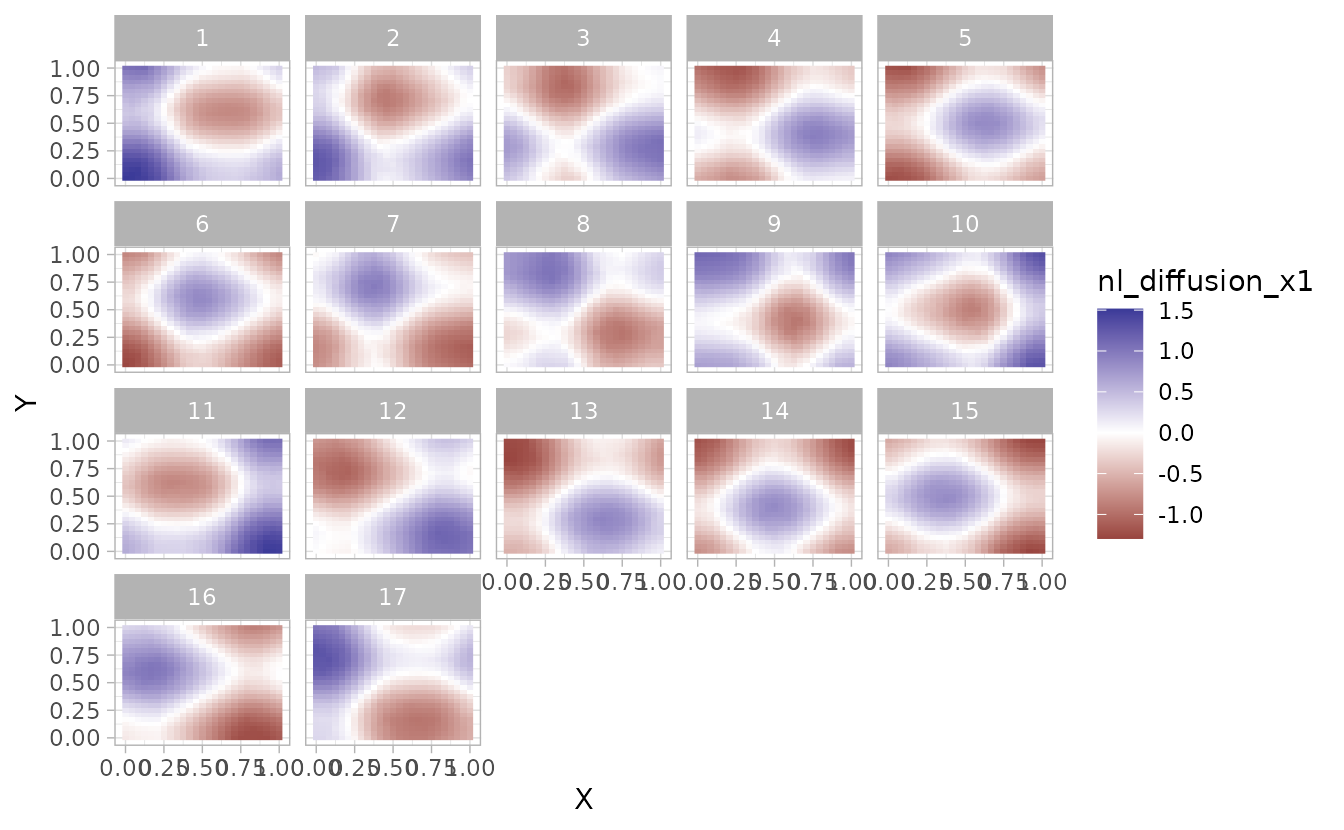
Plot diffusion kernels
We can inspect the spatial and temporal parts of the fitted operator, or the full joint effect, as either the impulse-response kernel or the transformed covariate field. By default, the diffusion kernel is shown at the mesh vertices:
plot_nonlocal_kernel(fit_st, component = "diffusion")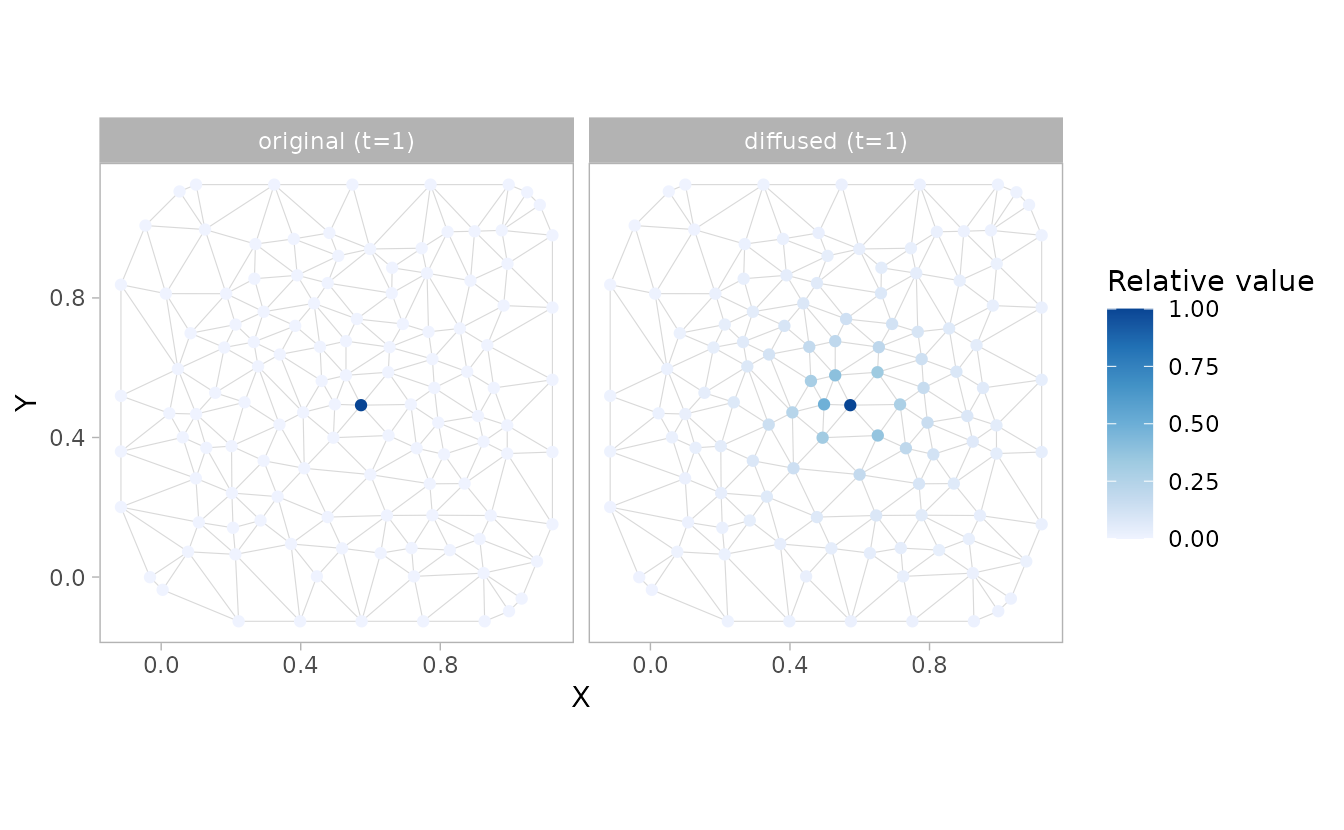
plot_nonlocal_kernel(fit_st, component = "time_lag", common_scale = TRUE)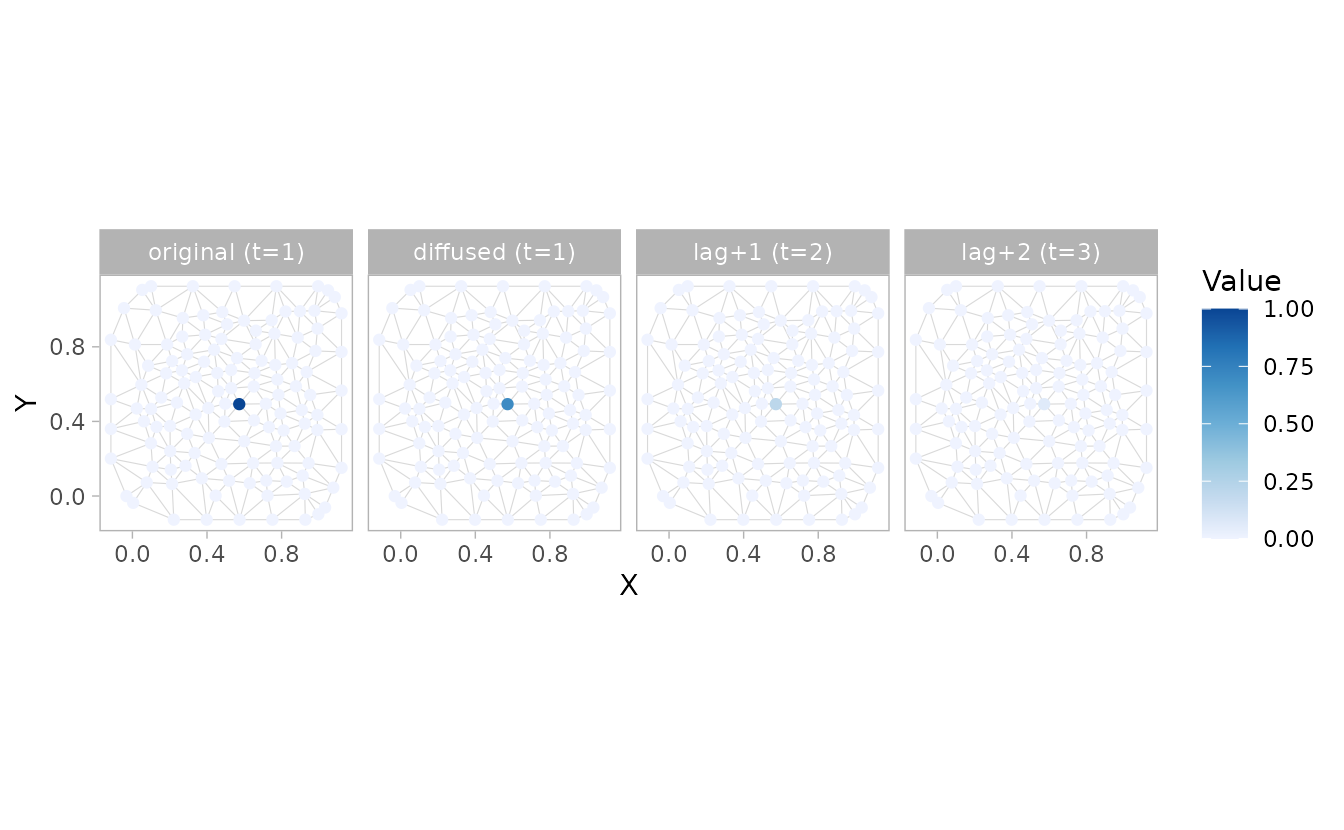
plot_nonlocal_kernel(fit_st, component = "combined")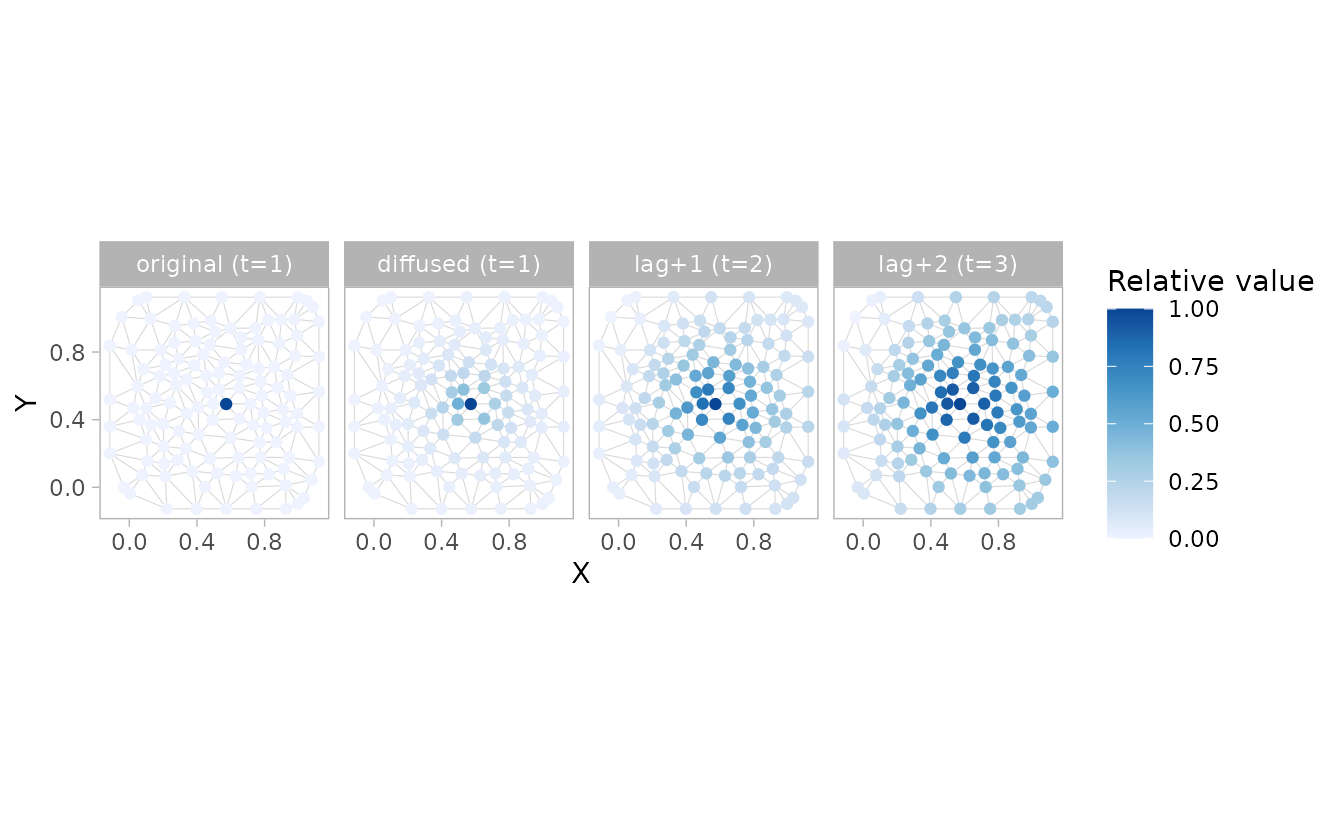
plot_nonlocal_kernel(fit_st, component = "combined", common_scale = TRUE)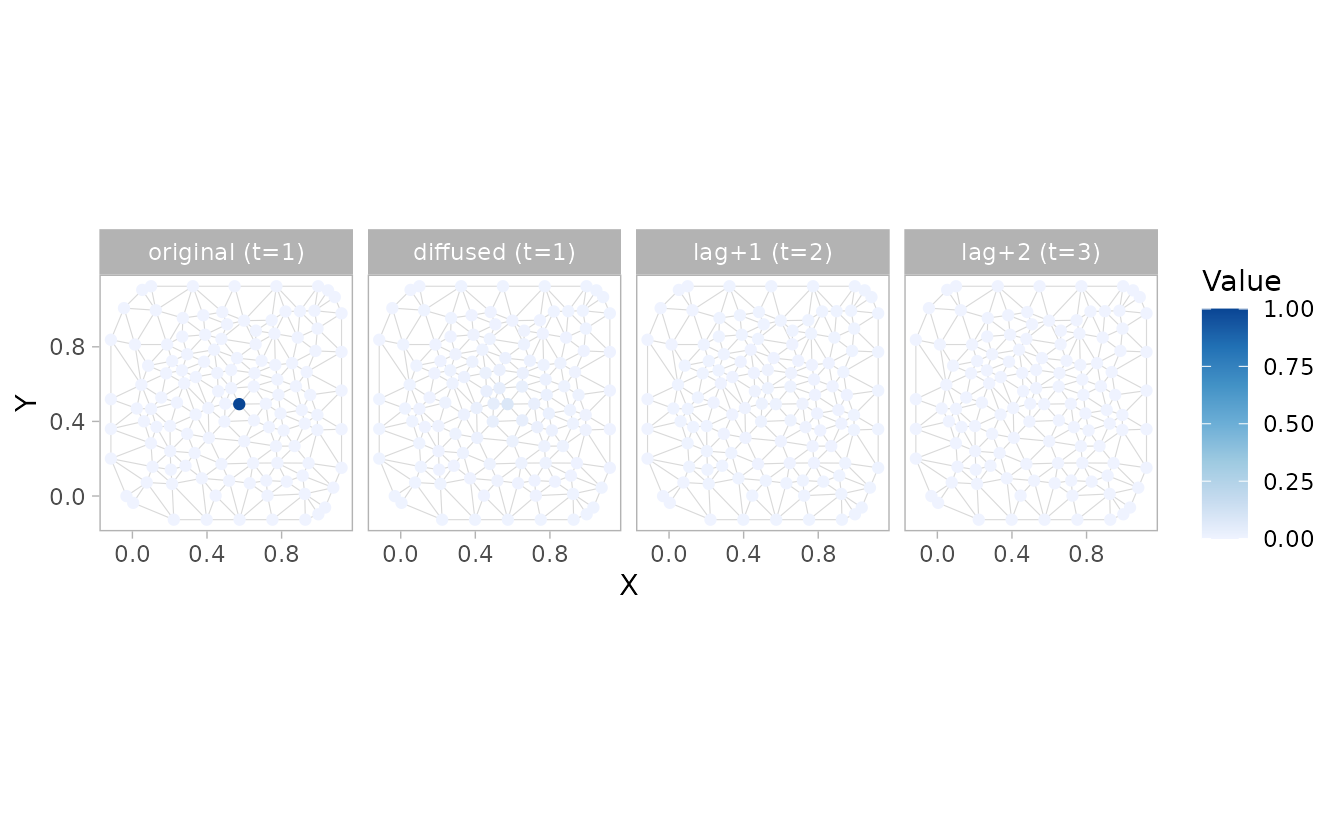
In the last case, the colour scale makes it hard to see the variation. We could add our own ggplot colour scale transformation:
plot_nonlocal_kernel(fit_st, component = "combined", common_scale = TRUE) +
  scale_colour_distiller(trans = "log10", palette = "Blues", direction = 1)
#> Scale for colour is already present.
#> Adding another scale for colour, which will replace the existing scale.
#> Warning in scale_colour_distiller(trans = "log10", palette = "Blues", direction
#> = 1): log-10 transformation introduced infinite values.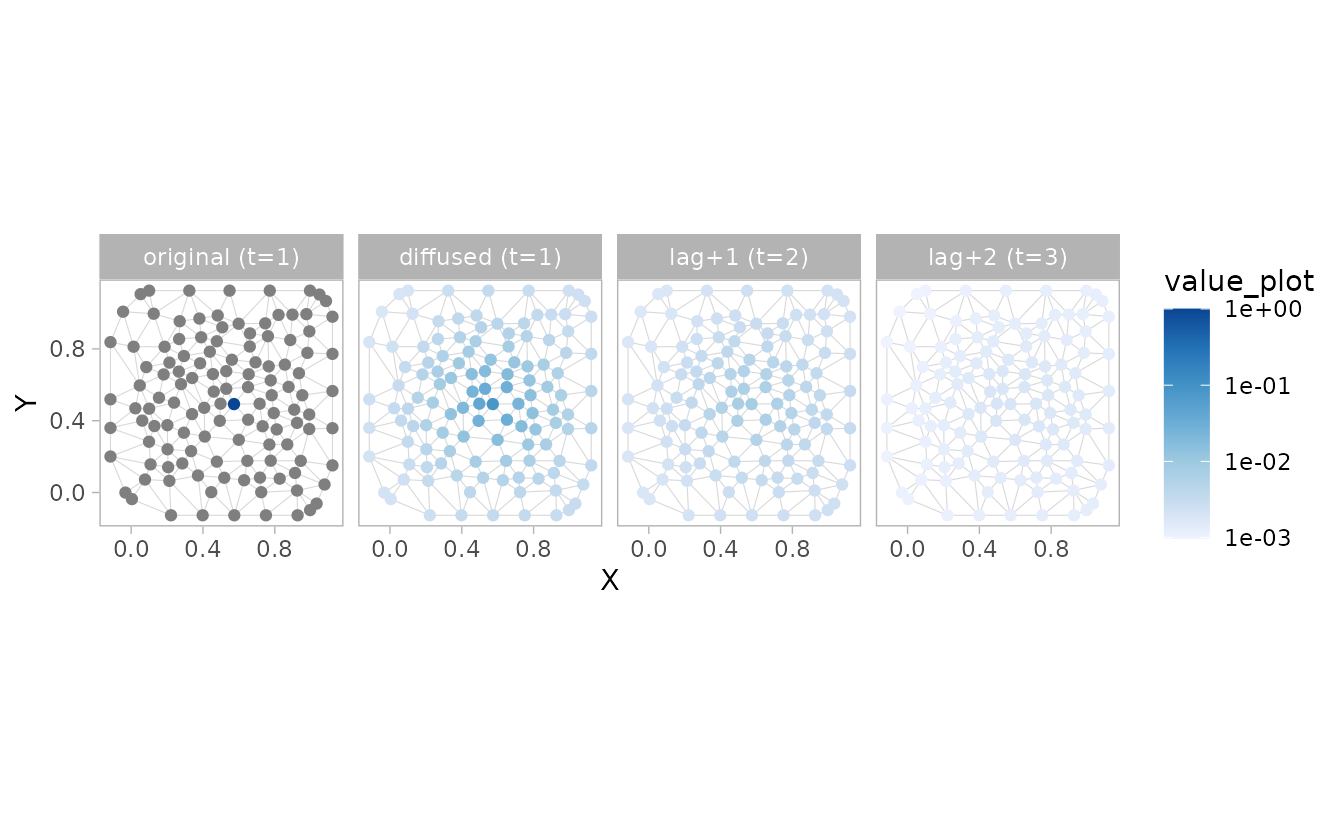
All the knots except one in the “original” panel were zero, so they become -Inf when log transformed, but now we can see the space and time nonlocal effects.
plot_nonlocal_covariate(fit_st, component = "diffusion")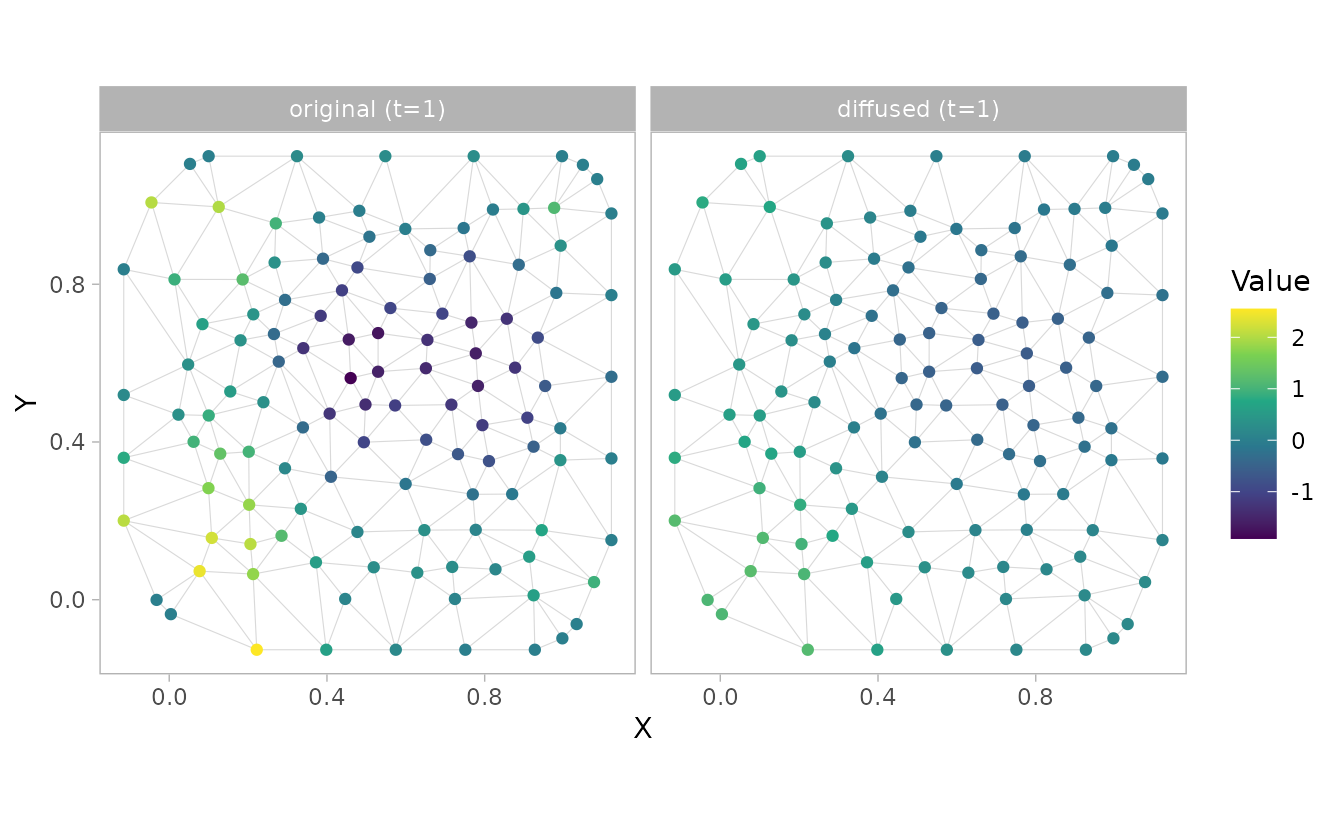
plot_nonlocal_covariate(fit_st, component = "time_lag", n_steps = 2)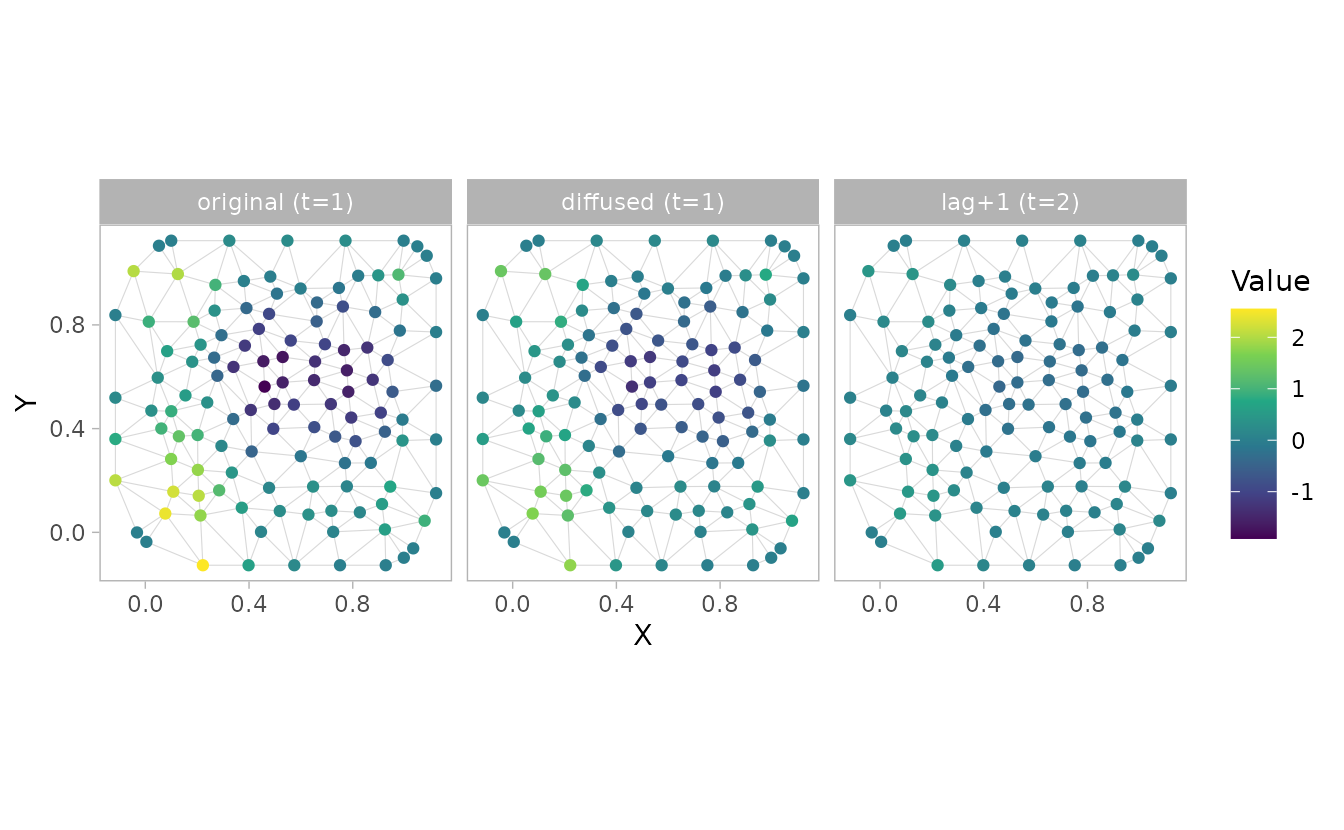
plot_nonlocal_covariate(fit_st, component = "combined", n_steps = 2)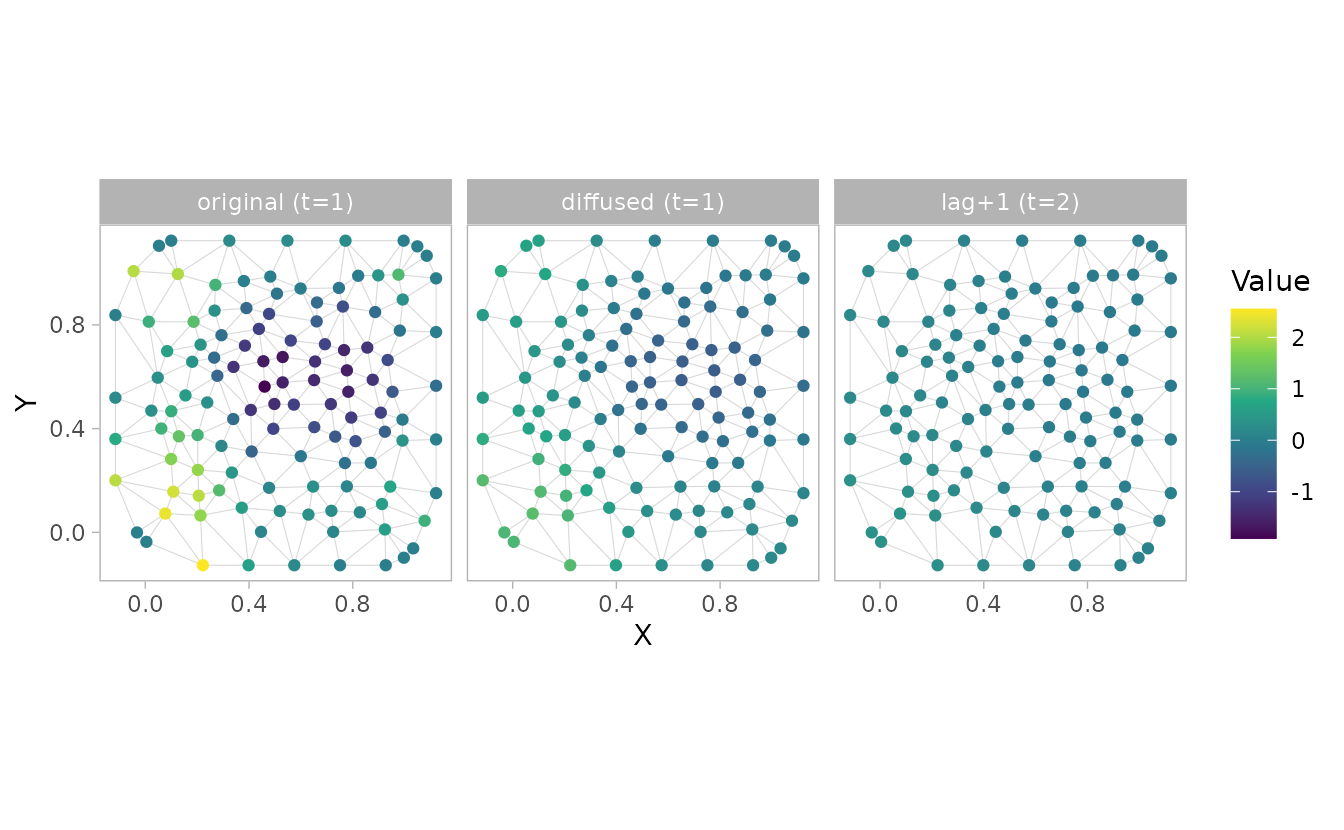
We could also have plotted the jointly transformed covariate at the original locations from the predictions.
pred <- predict(fit_st)

ggplot(pred, aes(X, Y, colour = x1)) + geom_point() +
  scale_colour_gradient2()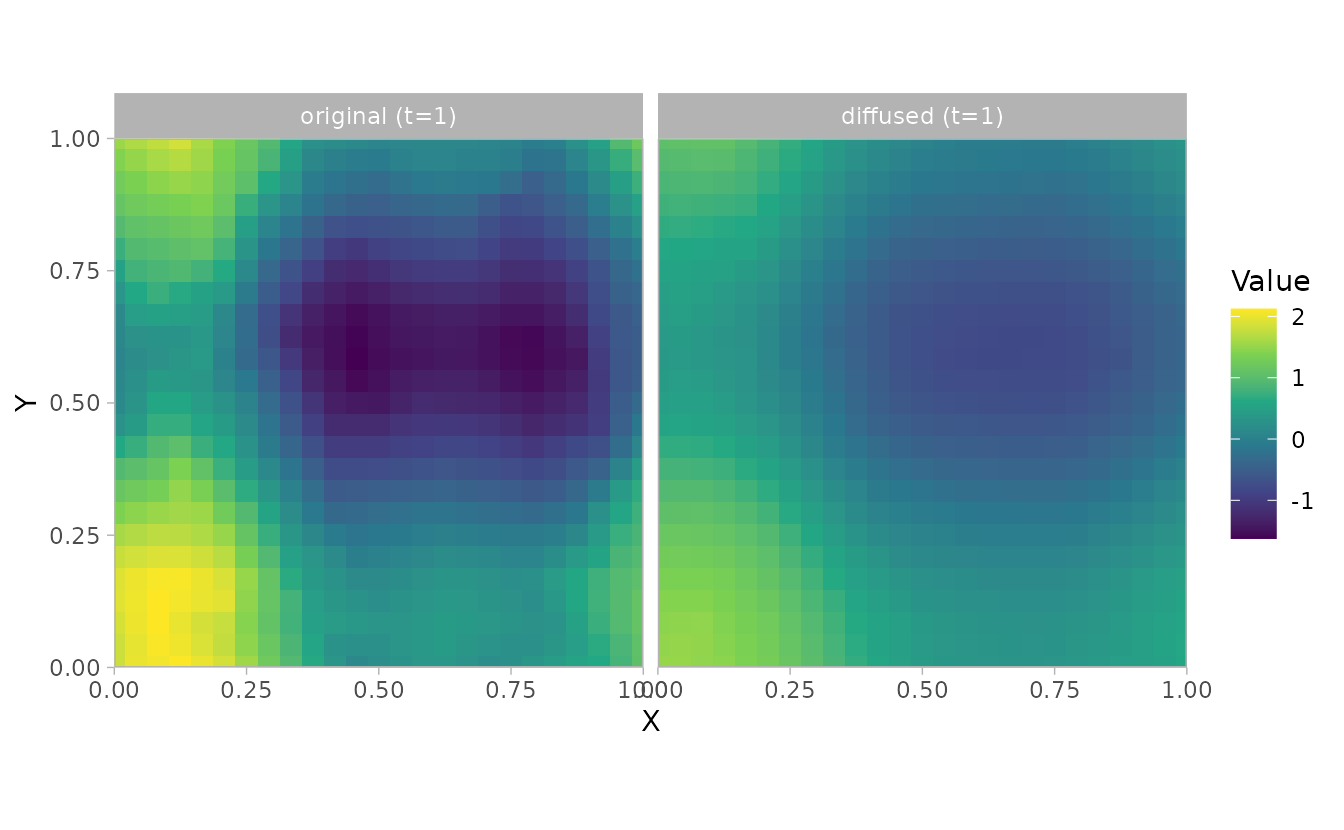
ggplot(pred, aes(X, Y, colour = nl_diffusion_time_lag_x1)) + geom_point() +
  scale_colour_gradient2()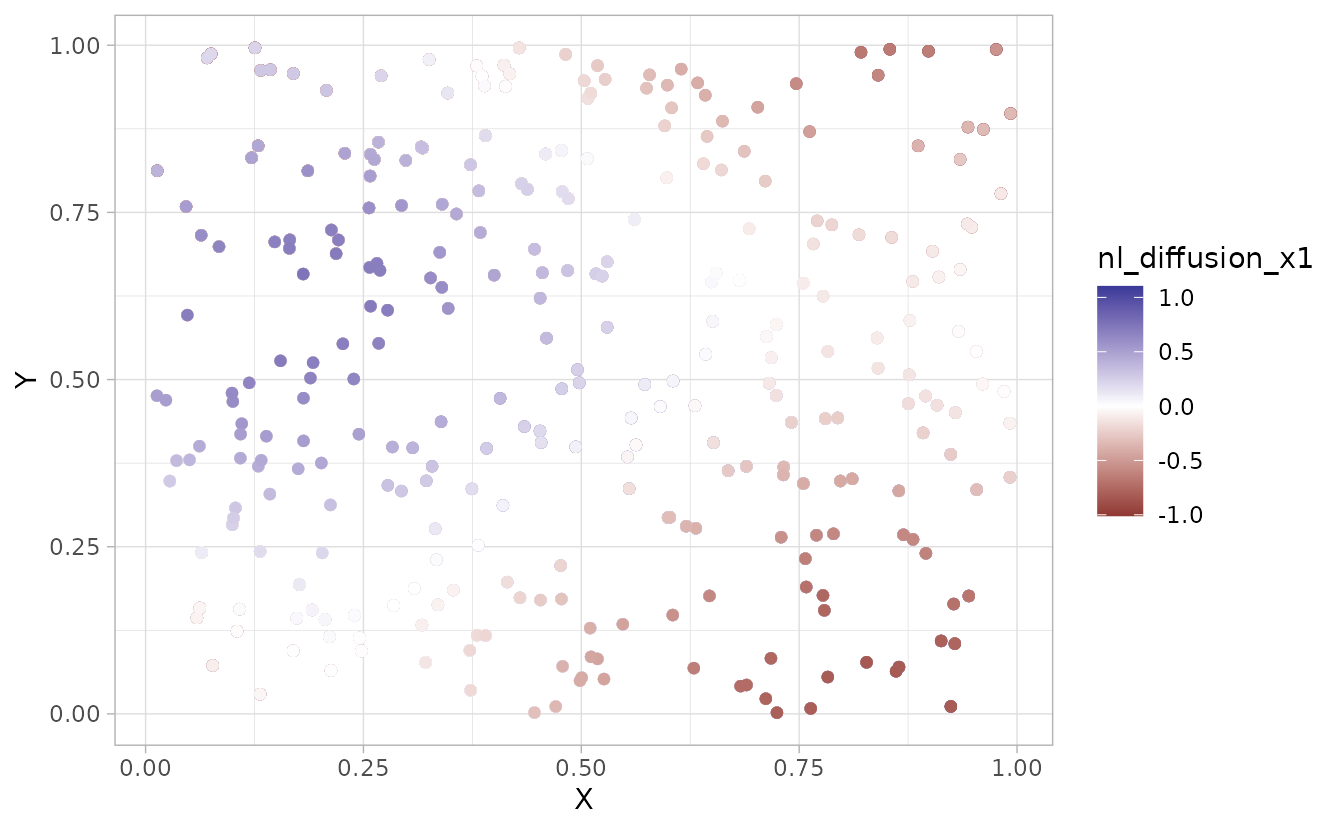
predict() vs. the non-local plotting functions
These two paths answer different questions, so pick based on what you need:
Use
predict()and thenl_*columns for the modeled effect. Columns such asnl_diffusion_x1,nl_time_lag_x1, andnl_diffusion_time_lag_x1are the transformed covariate values that enter the linear predictor at your data ornewdatalocations. The last name is used when both wrappers are applied tox1. Fortime_lag()these apply the stationary temporal recursion at each vertex, fordiffusion()they give the spatially smoothed field, and for the grouped space–time case they give the jointly transformed field. This is what you want for reporting, mapping the estimated effect, correlating against a known truth, or any downstream calculation. One column is returned per fitted transformed operator/design column.Use
plot_nonlocal_kernel()andplot_nonlocal_covariate()for diagnostics. These visualize how the estimated operator behaves.plot_nonlocal_kernel()shows the impulse response (how a point input spreads in space and/or decays through time) and cannot be reconstructed from thenl_*columns.plot_nonlocal_covariate()isolates a single input time slice and shows how it propagates forward overn_steps; it also offerscomponent = "combined"(the joint space-and-time response). This diagnostic uses the same joint operator as thenl_diffusion_time_lag_x1prediction column. Both plot on the mesh vertices by default, or at suppliednewdatacoordinates as points or a raster.
For the pure spatial diffusion() case at a single time
slice, plot_nonlocal_covariate() and mapping
nl_diffusion_x1 from predict() show the same
field, so either is fine. The plotting functions become most useful for
temporal (time_lag()) and combined terms, and
whenever you want to inspect the operator on the mesh itself.